
HVIA’s Chief Technical Officer Adam Ritzinger focused on regulatory and policy settings in a presentation to Mobility Live Australia in Melbourne last week.
Staged at the Melbourne Exhibition Centre, the event hosted 5,000 attendees, 200 speakers and 100 exhibitors across business, transport and government, all focussing on vehicle electrification, decarbonisation and associated mobility technologies.
Adam’s session centred on the need to get the right regulatory and policy settings to guide the transition to low- and zero-emissions heavy vehicles. It follows HVIA’s extensive decarbonisation advocacy work 2024, which included operating ‘TruckShowX’ in May in Melbourne, and numerous high-level conversations and submissions to federal and state government.
“My first message to Mobility Live attendees was that the decarbonisation transition is real, and it is happening, really quickly. We didn’t know it until we saw it at TruckShowX, but it was really a watershed moment for the industry”, he says.
“The transition is steaming along – right now we have hybrid vehicles, battery electric and fuel cell vehicles, and trailers with axles that can recover lost energy. Depots are converting to sustainable energy and electric hubs. There are plans for large-scale charging and refuelling facilities for trucks on key freight routes.
“So overall, in terms of what the industry is doing, we’re doing really well. But what we can achieve on our own is only a tiny portion of what we could achieve with the right regulatory and policy settings. That’s my second point, and we urgently need to get this right,” he adds.
For context, Adam lists two dozen issues the industry is facing, and explains that up to now, only one has been successfully addressed by regulators, which is truck width. Relaxation of the width restrictions from 2.5 metres to 2.55 metres allows manufacturers to import the next generation of low- and zero-emissions trucks from overseas markets, without costly re-engineering work.

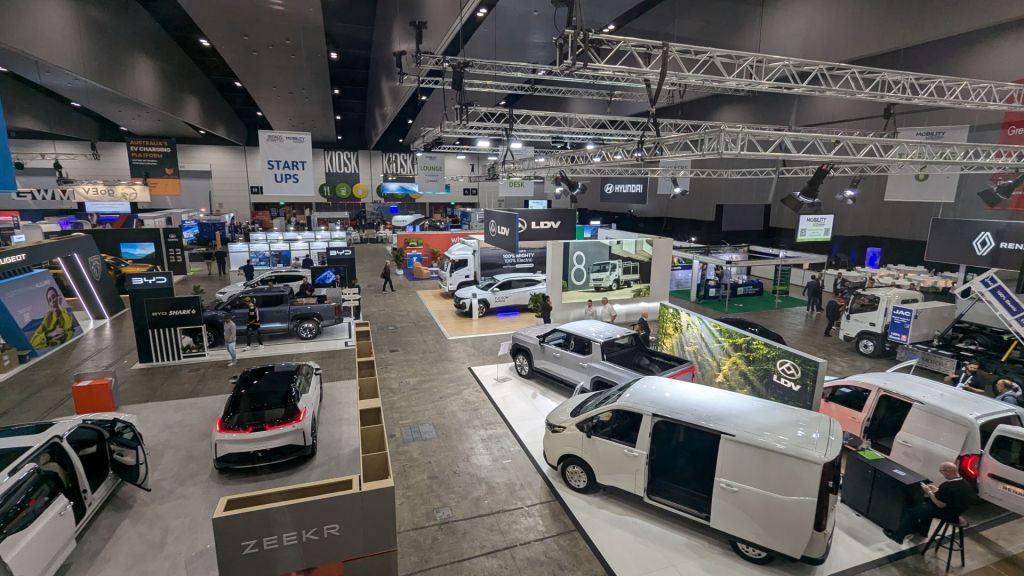
Mobility Live Australia hosted 5,000 attendees, 200 speakers and 100 exhibitors across business, transport and government
“Whilst it was undoubtedly a huge win for the industry, it took years of advocacy work to get over the line. That’s my third and final point. If we continue to rectify the regulatory and policy roadblocks at that rate, transport will become Australia’s highest-emitting sector, and we will overshoot our emissions reductions targets as well,” he says.
HVIA’s recommendations were explained in its recent submission to the Federal Government’s Net Zero Roadmap and Action Plan, which can be downloaded here. Adam summarises the major regulatory and policy needs, which are:
> A comprehensive plan for the roll out of a network of HV charging stations;
> Support for the sector in the operation and trial of hydrogen heavy vehicles;
> Incentivising and accelerating local supply of LCLF feedstocks, and LCLF refining;
> Supporting efforts to reduce emissions of the on-road vehicle fleet;
> Strengthening the PBS vehicle approval and access framework;
> Supporting LZEHVs through direct funding, incentives, R&D support and investment
> Strengthening the electricity grid to ensure adequate energy supply; and
> Enacting programs to develop skills within the workforce to support LZEHVs.
For more information, contact HVIA’s Chief Advocacy Officer, Adele Lausberg (a.lausberg@hvia.asn.au), or Chief Technical Officer, Adam Ritzinger (a.ritzinger@hvia.asn.au).