
Government regulation has emerged as the number-one challenge facing Australia’s heavy vehicle industry, according to Heavy Vehicle Industry Australia’s (HVIA) latest ‘Industry Snapshot’.
The survey of 60 industry leaders – available to download here – paints a clear picture of the pressures weighing on businesses across the heavy vehicle supply chain.
While economic uncertainty and workforce shortages remain significant concerns, regulation and government policy are now viewed as the largest constraints on business growth.
Six in 10 respondents reported that government policy or regulation is a major or enormous constraint on their business. Customer uncertainty followed closely at 58.3 per cent, while labour and skills shortages were identified as a major or enormous constraint by almost half of respondents.
The findings are particularly significant because they come from an industry that underpins Australia’s freight task, manufacturing capability and regional economy.
HVIA Chief Executive Officer Todd Hacking says the findings highlight growing frustration with regulatory complexity and delays at a time when Australia needs greater productivity, resilience and investment throughout the freight and manufacturing supply chain.

Above: What are the biggest constraints affecting your business health right now?
“The heavy vehicle industry supports around 600,000 registered trucks and directly employs more than 70,000 Australians, yet businesses increasingly feel trapped by a maze of overlapping and inconsistent regulatory requirements,” he says.
“Our members are telling us that regulation is delaying investment, slowing the rollout of new technologies and undermining confidence to expand their businesses.”
Businesses highlighted a wide range of regulatory concerns, including state-based vehicle standards, Australian Design Rules, workplace relations requirements and inconsistencies between jurisdictions.
Many respondents pointed to rising compliance costs, certification complexity and increasing administrative burdens.
The survey also revealed significant workforce challenges. Metal fabricators, engineers, automotive technicians and automotive electricians were among the occupations most difficult to attract and retain.
Workforce shortages are having broader impacts, with 43.3 per cent of survey participants identifying workforce constraints as a barrier to additional capital investment.
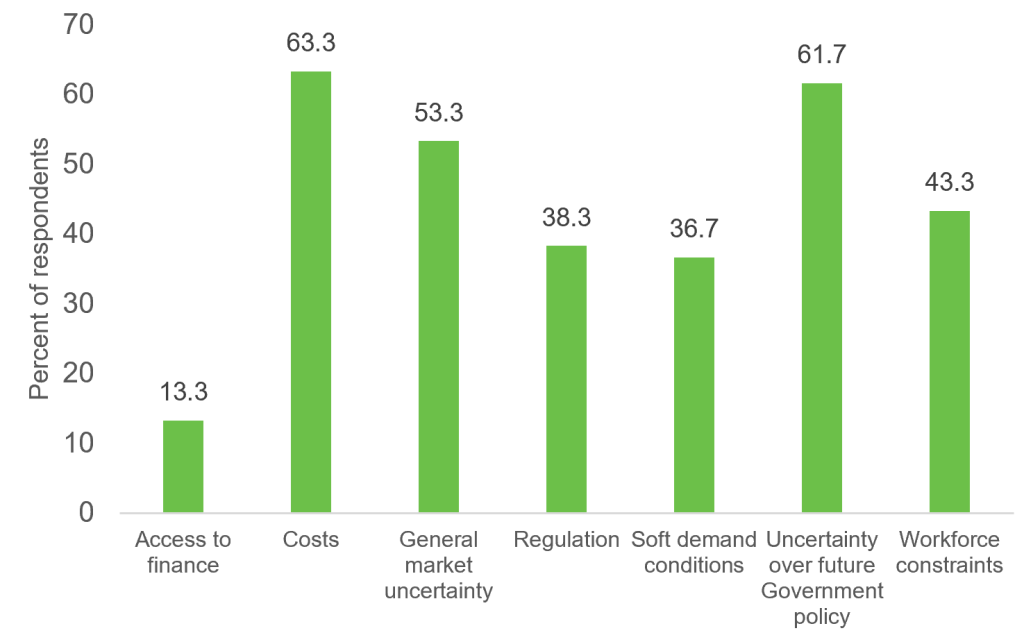
Above: What are the biggest barriers to capital investment?
These findings reinforce what HVIA members have been saying for some time: Australia’s regulatory framework is struggling to keep pace with technological change and evolving industry needs.
That is why HVIA is calling on the Australian Government to publicly release the findings of the ADR Harmonisation Review, commonly known as the Mundy Review. Consultation closed in January 2025 – more than 20 months ago.
The review represents the most significant examination of Australia’s vehicle regulatory framework in many years and provides an important opportunity to identify reforms that can reduce costs, improve consistency and support faster adoption of new vehicle technologies.
“The industry provided extensive input to the Mundy Review and is now waiting to see its recommendations,” Hacking says.
“Australia cannot afford to leave productivity-enhancing regulatory reforms sitting on a shelf. The release of the Mundy Review would support greater clarity in vehicle regulation, unnecessary compliance costs and help accelerate the deployment of safer and cleaner heavy vehicles.”
For an industry increasingly investing in zero-emission vehicles, advanced safety technologies and productivity-enhancing innovations, modern and efficient regulation is essential.
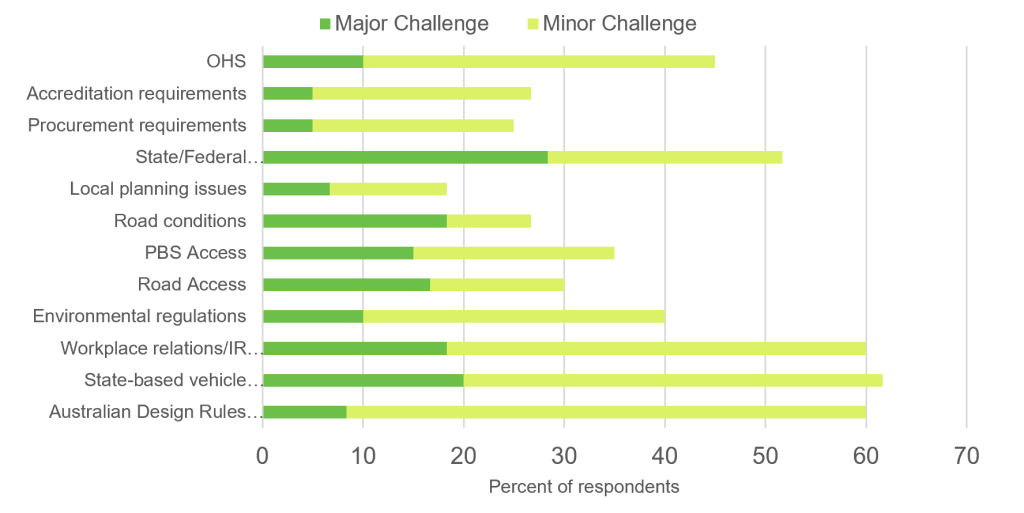
Above: Which regulatory areas create the greatest challenge?
The ‘Industry Snapshot’ shows businesses are not seeking lower standards. Rather, they are asking for clearer, more consistent and more efficient regulatory processes that support investment and innovation while maintaining safety outcomes.
The report concludes that action is needed in three key areas: streamlining regulation, improving consistency across jurisdictions and strengthening workforce pathways.
Collectively, these reforms would help unlock investment, improve productivity and support sustainable growth across Australia’s heavy vehicle sector.
As economic uncertainty rises and international tensions continue to impact supply chains, the message from industry is clear: now is the time to remove barriers to growth and give businesses the confidence to invest in Australia’s freight future.
HVIA’s immediate priority is the release of the Mundy Review and a clear commitment from governments to implement meaningful regulatory reform that supports a safer, more productive and more competitive heavy vehicle industry.
“The heavy vehicle industry is ready to invest, innovate and grow, but governments must remove the barriers that are holding businesses back,” Hacking says.