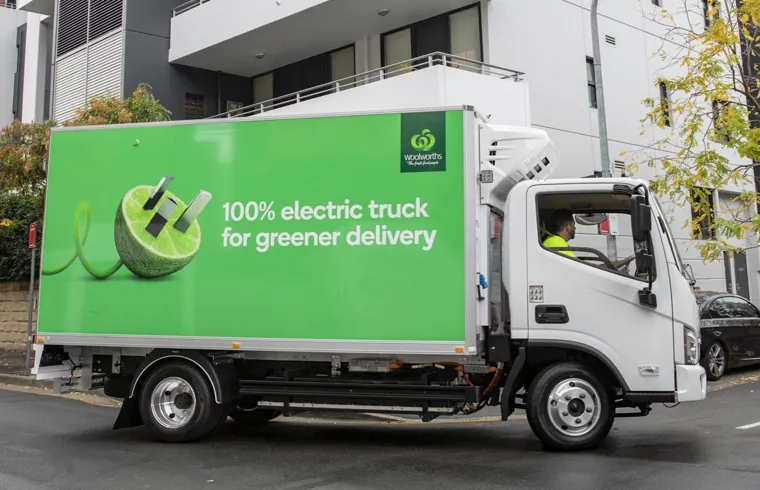
The Clean Energy Finance Corporation has invested up to $6 million to get more Battery Electric Trucks on Australian roads with global electric fleet specialist Zenobē, which will lease the vehicles to supermarket giant Woolworths, reducing emissions for grocery deliveries and on-road transport in NSW and Victoria.
The CEFC finance supports the delivery of a fleet of 60 Battery Electric Trucks (BETs) for ‘last-mile’ deliveries – the final leg of the delivery journey to homes and businesses – to replace diesel vehicles and help reduce emissions in the transport sector.
Truck fleet electrification presents significant operational and logistical challenges, including high upfront costs, insufficient charging infrastructure, battery replacement and grid integration, all of which are compounded by existing complexity in the broader freight and logistics sector.
“This support from CEFC enables us to deliver electric trucks and charging infrastructure for Australia’s largest supermarket retailer,” says Gareth Ridge, Country Director of Electric Vehicle Fleets at Zenobē.
Zenobē’s ‘Electric Vehicle as a Service’ (EVaaS) model addresses these challenges by enabling the deployment of both BETs and charging infrastructure for Woolworths.
CEFC Head of Infrastructure Julia Hinwood adds, “The heavy truck sector is a central part of Australia’s economy and supports the supply chains of most industries. Electrifying Australia’s heavy vehicle fleet is crucial for achieving national emissions reduction targets.
“This CEFC investment will support infrastructure development for the BET industry that supports Zenobē leasing fixed price BETs, an innovative model that can be adopted by the broader freight and logistics sector.
“Investing in Zenobē’s shared infrastructure model will allow major logistics and freight operators and users to transition to electric vehicles (EVs) without the significant capital expenditure and complexity associated with the uptake of BETs.
“It is essential to address the finance gap present in electrification of heavy fleet transport to accelerate the decarbonisation requirements within the sector. This is a significant opportunity to accelerate the transport sector’s transition to a green fleet and introduce a new model for heavy fleet charging, leveraging the expertise of Zenobē.”

A 3D render of Woolworths shared charging hub for BETs in Mascot, NSW
Ridge says the support from the CEFC enables it to deliver electric trucks and charging infrastructure for Australia’s largest supermarket retailer.
“Through our Electric Vehicle as-a-Service model, we handle the upfront cost and complexity of fleet electrification and manage the entire transition so our customers can focus on their core business. Our work with the CEFC shows that electrifying the truck sector is not a distant ambition. It’s achievable today,” he says.
Henri Le Comte, Woolworths Group Head of Partnerships, HomeRun, says the partnership with Zenobē will enable the retailer to deploy a further 60 BETs and launch the first-of-its-kind charging hub in Australia.
“Working with Zenobē has allowed us to scale our EV fleet quickly, helping to make our suburban streets just a little quieter and cleaner. Through Woolworths’ continued investments in EV operations and infrastructure, we hope to set an example for other businesses to support the growth of Australia’s EV industry,” he says.
The 60 BETs financed by the CEFC are part of a broader $19 million project funded by ARENA and Zenobē, which includes the development of Australia’s first off-site multi-user charging hub for BETs in Mascot, NSW.
Woolworths and other BET users will use the hub to drive down emissions, with approximately 20 of the CEFC-backed trucks to be based in the Mascot depot. The remaining CEFC-financed trucks will be deployed across various locations in NSW and Victoria. Woolworths Group has previously announced its intention to transition its Woolworths home delivery trucks to EVs by 2030.
Transport accounts for up to 22.3 per cent of Australia’s national emissions, and is the fastest growing source of emissions. Without intervention, it is expected to be Australia’s largest source of emissions by 2029. BETs represent a substantial opportunity to decarbonise the sector, but sales of BETs compared to internal combustion equivalents remain insignificant.
To March 31, 2025, the CEFC has helped finance more than 14,000 electric vehicles, exceeding $900 million in value, including third-party capital. The CEFC has also invested over $190 million in other electric vehicle-related projects since inception to help decarbonise Australia’s transport sector, including backing for Team Global Express to accelerate the electrification of its truck fleet and finance for Australia’s first electrified bus fleet with Zenobē.