Artificial intelligence (AI) is moving rapidly from novelty to business infrastructure, but Australian companies still have work to do to turn that capability into genuine productivity and measurable return on investment.
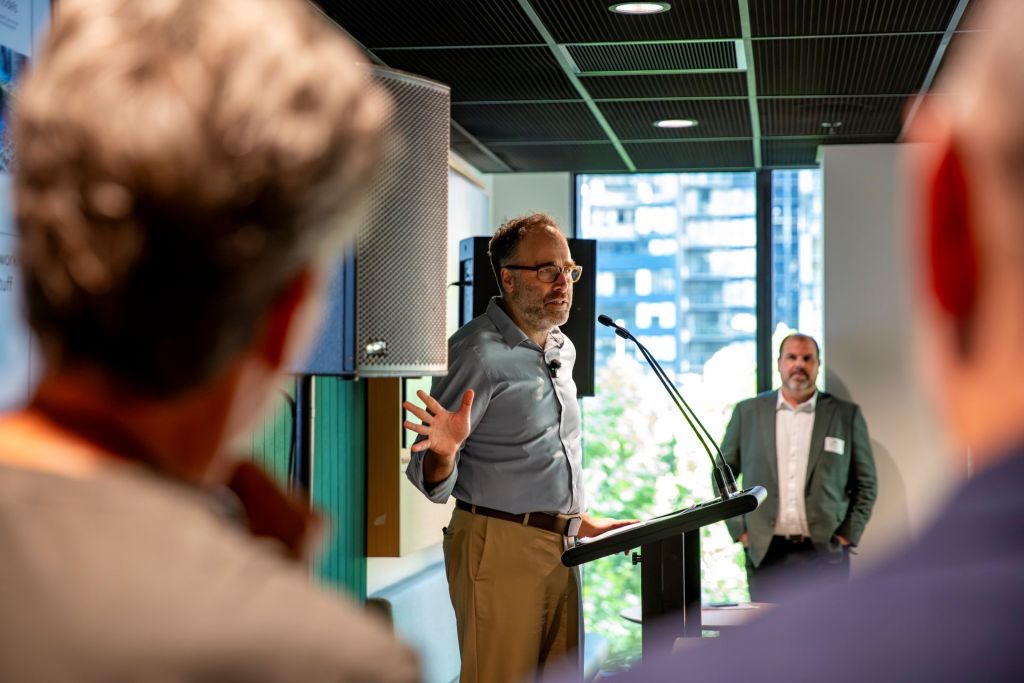
That was one of the key messages from CSIRO Chief Research Consultant Dr Stefan Hajkowicz (pictured above) at HVIA’s Executive Club held Thursday, October 29 in Melbourne, where he challenged industry leaders to think beyond AI hype and focus on practical value.
Hajkowicz, who led the development of Australia’s National AI Roadmap and AI Ethics Framework, told industry leaders that the productivity challenge facing Australia would not be solved by technology alone – but by businesses finding smarter, faster and safer ways to apply it.
“The solutions to productivity are with the people in the room here,” Hajkowicz told members, arguing that the real opportunity is in using technology to work “smarter, faster, safer”.
His presentation traced the extraordinary acceleration of AI capability before turning to what he described as a “second wave” – moving from AI that tells us things to AI that increasingly does things for us.
“Turning AI into ROI for a lot of CEOs is tough, and it’s not clearly happening,” Hajkowicz said. “Almost everyone’s using it, nobody’s banking it,” he added, pointing to international research showing a wide gap between AI adoption and measurable profit impact.
For HVIA members, the challenge is already very real. HVIA’s 2026 Industry Leaders Survey found 85 per cent of responding companies were already using AI or actively exploring it, but skills and cyber security remained the biggest barriers to adoption.
“Every use case runs on what your business already knows,” Hajkowicz said, before demonstrating how AI could increasingly support a heavy vehicle business across the full life of a job – from quoting and design through to approvals, manufacture and service.
One example prepared specifically for the presentation pushed that discussion further. An advanced AI model was asked to develop a concept design for a tri-axle trailer carrying eight-metre RHS steel posts.
HVIA Chief Technical Officer Adam Ritzinger reviewed the result and described it as “scarily advanced”.
The model produced a 10-page concept pack, including drawings and calculations, while also identifying where proper engineering validation was still required.
Hajkowicz’s conclusion was not that AI could simply replace engineers, but that it could help them work faster, tackle bigger challenges and redirect more of their effort towards creativity, customer needs and higher-value work.
That distinction is especially important for Australia’s heavy vehicle sector, where much of the work is low-volume, highly customised and engineering-intensive.
The bigger question is not simply how businesses use AI, but whether the technology can help strengthen Australian manufacturing, engineering and technical capability in the face of intensifying international competition and growing uncertainty across global markets, geopolitics and supply chains.
For companies wondering where to begin, Hajkowicz kept the advice simple: choose one workflow, start with a real pain point, protect your data, keep qualified people in the loop and measure the result.
The Executive Club event followed HVIA’s AGM, at which Shay Chalmers was elected HVIA President. Members who missed the session – or want to revisit the discussion – can watch the full presentation and explore further information on the HVIA Training website.