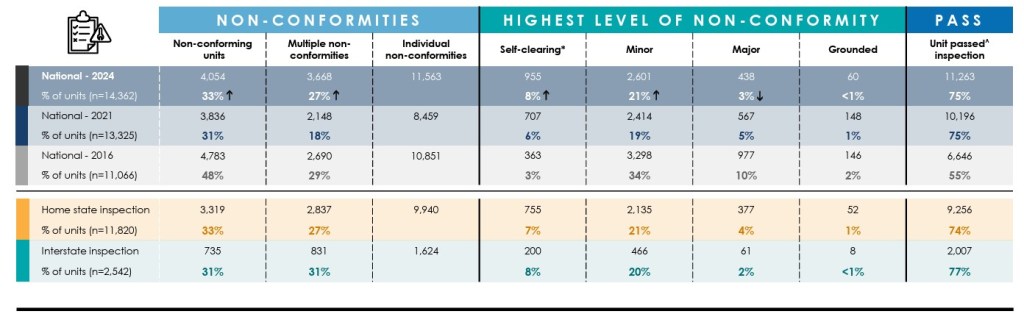
Seventy-five per cent of units passed inspection in the NHVR’s latest national roadworthiness survey – the same percentage as the 2021 survey, continuing the strong improvement over the 2016 benchmark survey of 55 per cent.
The survey – conducted between July and October 2024 across all states and territories –inspected 9,082 vehicles and combinations with an average age of 10.2 years and a median mileage of just over 316,000km, making it the largest in-depth health check ever conducted.
NHVR Chief Operating Officer Paul Salvati says that while three-quarters of units passed inspection, the percentage of units with at least one non-conformity, at 33 per cent, was a small but statistically significant increase from 31 per cent in 2021. The incidence of non-conformity remains well below 2016 levels.

According to a snapshot published by the NHVR, the number of major defects that resulted in the grounding of the vehicle were slightly better than the 2021 results, at less than 1 per cent, but the self-clearing (up from 6 per cent to 8 per cent) and minor defect (up from 19 per cent to 21 per cent) categories showed slight increases.
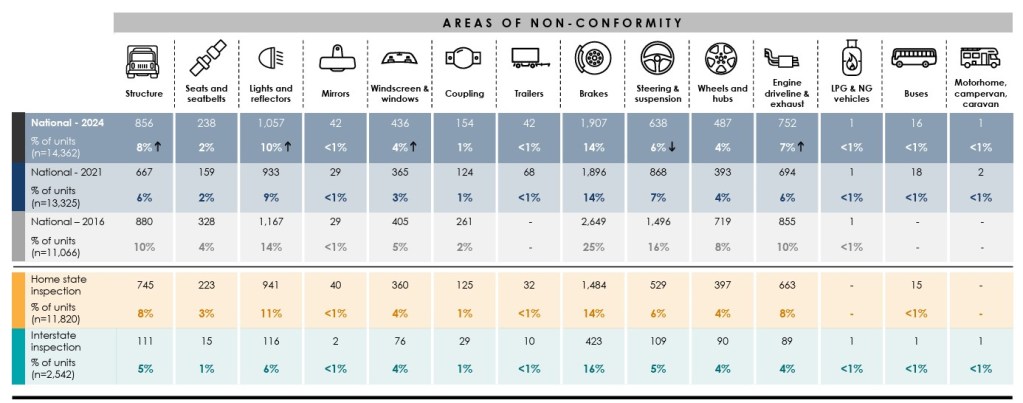
The most common non-conformity was brakes, followed by lights and reflectors. Structure and body, engine driveline and exhaust, and steering and suspension, were also in the top-five most common areas of non-conformity.
Structure, lights and reflectors, windscreens and windows, and engine and exhaust categories showed small but statistically significant increases on the 2021 results. The only area to show a significantly significant decrease was steering and suspensions.
Notably, the highest incidence of non-conformity occurred in rigid trucks (39 per cent), however this remains a significant decrease from 2016 (52 per cent).
“The NHVR is still concerned that defects in brakes remains a top issue, and I would like to take this opportunity to remind operators and drivers of their responsibility to ensure their vehicles are properly maintained and daily vehicle checks are conducted,” Salvati says.
“The sheer scale of the 2024 NRS has allowed us to see where the NHVR and industry are making improvements in safety and where more attention is needed to focus our regulatory efforts and future safety initiatives.
“We know that these inspections did result in a longer than normal intercept time, and I wanted to thank industry and drivers in particular for their patience and support while we undertook these crucial checks at the roadside.
“I know the impacts of this survey will enact positive results on the efficiency and productivity of the heavy vehicle industry, including safer roads for all road users.”