
The Australian Government this week unveiled a series of significant measures aimed at addressing growing industry concerns about fuel supply and pricing, including a halving of the fuel excise and the removal of the heavy-vehicle road user charge for the next three months.
At a press conference held on Monday following National Cabinet, Prime Minister Anthony Albanese also revealed the next scheduled increase in the Heavy Vehicle Road User Charge would be deferred by six months.
The concessions will save motorists 26 cents a litre and operators of heavy vehicles over 4.5 tonnes 32.4 cents per litre. Both measures commence Wednesday, April 1, and will cost the Budget an estimated $2.5 billion.
The Australian Competition and Consumer Commission will monitor fuel prices to help ensure that the lower excise rate is fully passed on at the bowser.
“While Australia’s fuel supply outlook remains secure in the near term … the longer this war goes the worse the impacts will be. We are acting now to prepare and shield Australians,” he said.
Fuel Supply
National Cabinet also agreed to adopt a Fuel Security Plan which has four stages. Australia is at the second stage (‘keeping Australia moving’), with stage three ‘taking targeted action’ and stage four ‘protecting critical services for all Australians’.
Under stage two, key Commonwealth actions will include: bilateral engagement with key trading partners to shore up domestic supply; underwriting additional fuel cargoes and other vital strategic reserves, such as urea and plastic resins, as needed; diverting supply to the domestic market through changes to fuel standards; and managing reserves under the Minimum Stockholding Obligation.
The Government has already announced temporary adjustments to petrol quality standards and diesel standards to help suppliers bring more fuel into the domestic market for farmers, truckers and regional communities.
In addition, on Saturday the Government announced the establishment of new fuel security powers to enable it to work with fuel suppliers to keep fuel flowing to Australia.
In particular, amendments to the Export Finance and Insurance Corporation Act will enable Export Finance Australia to enter contracts of insurance or indemnity, give guarantees, make loans, or enter arrangements needed to help secure fuel supply from international markets.
Commonwealth powers will only be used to help acquire additional supply that is valuable for Australia’s fuel security and where would be cost prohibitive for private suppliers to source on commercial terms without government support. Support will not replace or subsidise fuel that importers are already contracted to supply.
“We are already in discussions with local and international fuel suppliers to help them source additional cargoes as needed to keep our nation and our people moving. Our focus will be on ensuring additional supply helps address regional shortages and critical supply gaps,” Albanese said on Saturday.
“Despite stable national supply, global price pressures and a doubling in demand has seen parts of Australia’s regional fuel market come under significant strain. This has had an unacceptable impact on regional customers who source their fuel this way, including farmers.
“The Fuel Security powers help to address this by giving suppliers confidence to secure additional and discretionary cargoes – which will be used to service uncontracted demand, including regional and independent fuel suppliers.
“Eligibility for underwriting support will be structured to ensure additional supply can be delivered quickly through trusted operators with the capability and networks to get fuel where it needs to go.”
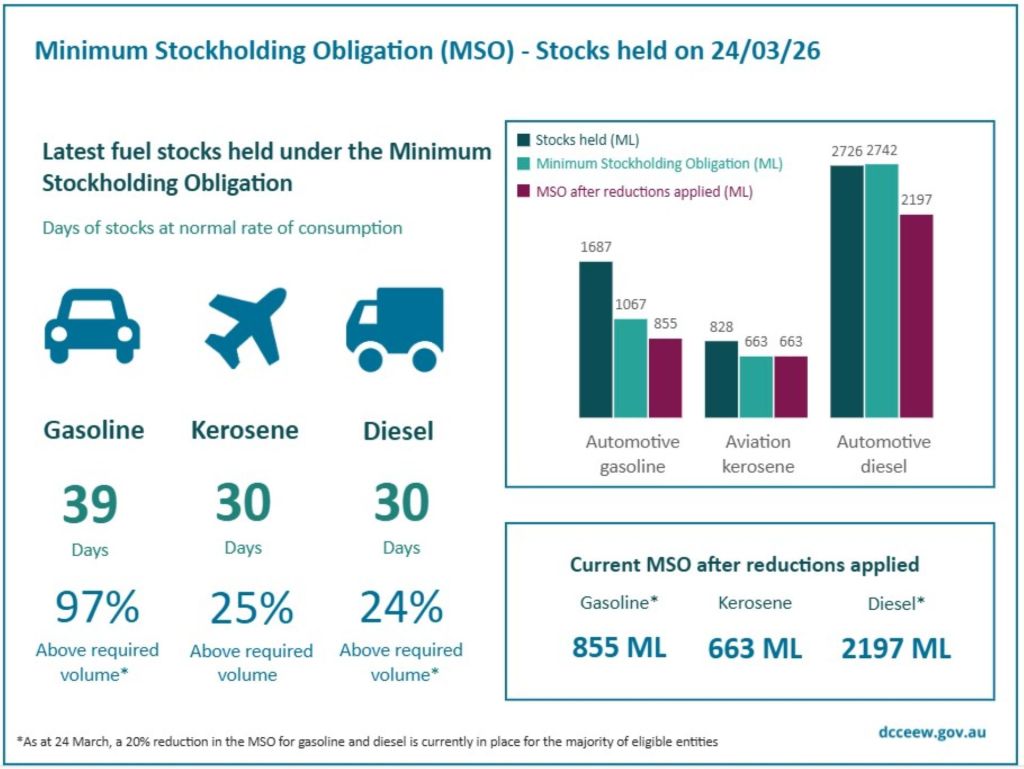
The most recent data shows fuel stocks held under the Minimum Stockholding Obligation (MSO) were virtually unchanged in the seven days to Tuesday, March 24, compared to the previous corresponding week.
The data – which is now being released weekly – shows diesel stocks sat at 2.726 billion litres (2.804 billion previously), the equivalent of 30 days’ supply and 24 per cent above the “required volume”.
Petrol stocks topped 1.687 billion litres (1.644 billion previously), equating to 38 days’ supply, 78 per cent above the “required volume”; and aviation fuel stocks stood at 828 million litres (unchanged), enough for 30 days’ supply, 18 per cent ahead of the “required volume”.
A joint statement issued after Monday’s meeting stated that National Cabinet “will continue to assess whether higher levels of action are needed and will plan accordingly.
“Any shift in level will be signalled by the National Cabinet, including through consultation with relevant industries and sectors, to ensure additional measures are well-designed and work efficiently,” the statement said.
Looking ahead, First Ministers also noted that beyond the “immediate challenges”, governments “must all build fuel and energy resilience to shield the Australian community and industry from future global shocks.
“At the heart of this is unlocking affordable and sovereign energy to underpin Australian industry, lower power prices, and maintain Australia’s status as a trusted and reliable energy exporter.”