As the NHVR’s Lead Mechanical Engineer PBS since January 2026, Saizo Takeuchi now leads the teams responsible for the assessment and approval of all Performance Based Standards (PBS) Design and Vehicle Approvals.
His role also sees him support other areas across the National Heavy Vehicle Regulator (NHVR), drawing on his extensive knowledge of the PBS scheme and a strong understanding of industry perspectives.
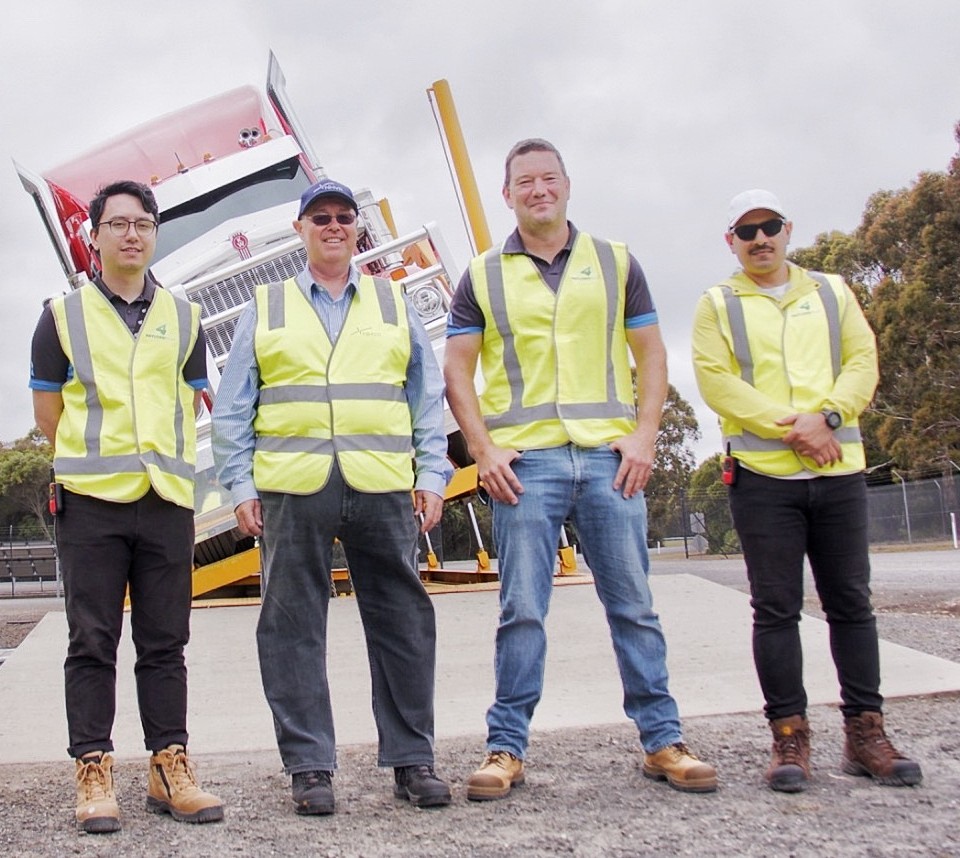
Prior to joining the NHVR, Saizo (pictured above left with NHVR Chief Engineer Les Bruzsa, Advantia MD Victor Trumper and Mechanical Engineer Sina Milani back in May 2024) worked for years as General Manager of Advantia Transport Consulting, where he supported operators and stakeholders to engage with and benefit from the PBS scheme as an access and policy consultant, PBS Assessor and PBS Certifier.
So, he is certainly not new to the PBS scheme itself and brings much-valued industry experience to the regulator which industry will benefit from.
Some months in to his new role, we thought we would check in with Saizo for an inside look at PBS at the NHVR.
How is the new role going?
It’s been a very rewarding and engaging experience to hit the ground running at the NHVR. We’re continuing to see record numbers of vehicles enter the PBS scheme with the overall PBS fleet exceeding 30,000 combinations last year, and 2026 looks to not be slowing down.
With the PBS DA, VA and now PBS enhancements teams sitting with me, there have been many challenging and interesting topics raised within these teams. Currently the NHVR is taking on a lot of change – things like the HVNL reform, updates to Euro VI, digitisation of the PBS systems and the on-going updates to the standards, with DSUB as the next standard off the block.
It’s an exciting time to have joined the organisation. My focus is on continuing to progress PBS in a way that balances productivity with safety outcomes, ensuring the scheme continues to deliver strong benefits to industry and the community. I’ve also been fortunate to join a highly capable team, which has made the transition into the NHVR very easy.
What do you see as the key opportunities within the PBS framework?
While there is the overall primary benefit of PBS in that vehicles can be optimised for productivity while delivering significant safety and infrastructure wins, I think over the next few years the key opportunities will be around access for PBS vehicles to drive even further uptake.
In my mind this is delivered on two fronts.
Firstly, we have opportunities to make the overall PBS process, from vehicle design to access permit, faster. This includes both our own digitisation efforts, expansion of the PBS Pre-Advised scheme, but then also working with road managers to further support the automated access decision-making tools, such as Victoria’s HVSAPS, Tasmania’s HVAMS and the National Automated Access System (NAAS). As your members will be intimately aware, even a few days of lost productivity from a vehicle being unable to operate may be equivalent to thousands of dollars.
The second front here is through enhanced use of data, both on vehicles and then on road assets to potentially enable greater levels of access. We are continuing to work on providing enhanced data visibility and collection to feed into the decision-making progress so that road managers have all the information available to them to make informed choices about access.
How can HVIA and its members best work with the regulator to improve the PBS system?
The main thing is just keeping the communication lines open and frequently used. I think HVIA and the NHVR have and continue to work well together on this front, but it can’t hurt to have more feedback flow through to us. As mentioned earlier, there is a lot happening in the PBS space now, and so if there are concerns, important topics or questions that are relevant for members we need to know about them to ensure we are getting the right information out there.
The other type of information I personally would love to hear from members is just what are your blue-sky ideas, and this might be specific PBS projects you are looking to get off the ground or ways you would change the PBS system. We are always thinking about how to improve the scheme ourselves, but as a regulator we can come at the problems with a certain mindset and may inadvertently overlook possibilities. Some of the stand-out wins for the PBS scheme started with conversations with industry members about just how something might be done differently or better.
A message from us
On behalf of HVIA, good luck with the new role Saizo and we will certainly keep communications open and the blue-sky ideas coming!