With a long history starting with a blacksmith’s shop in the German town of Altenberge in 1892, Schmitz Cargobull currently enjoys the enviable position of Europe’s leading trailer manufacturer.
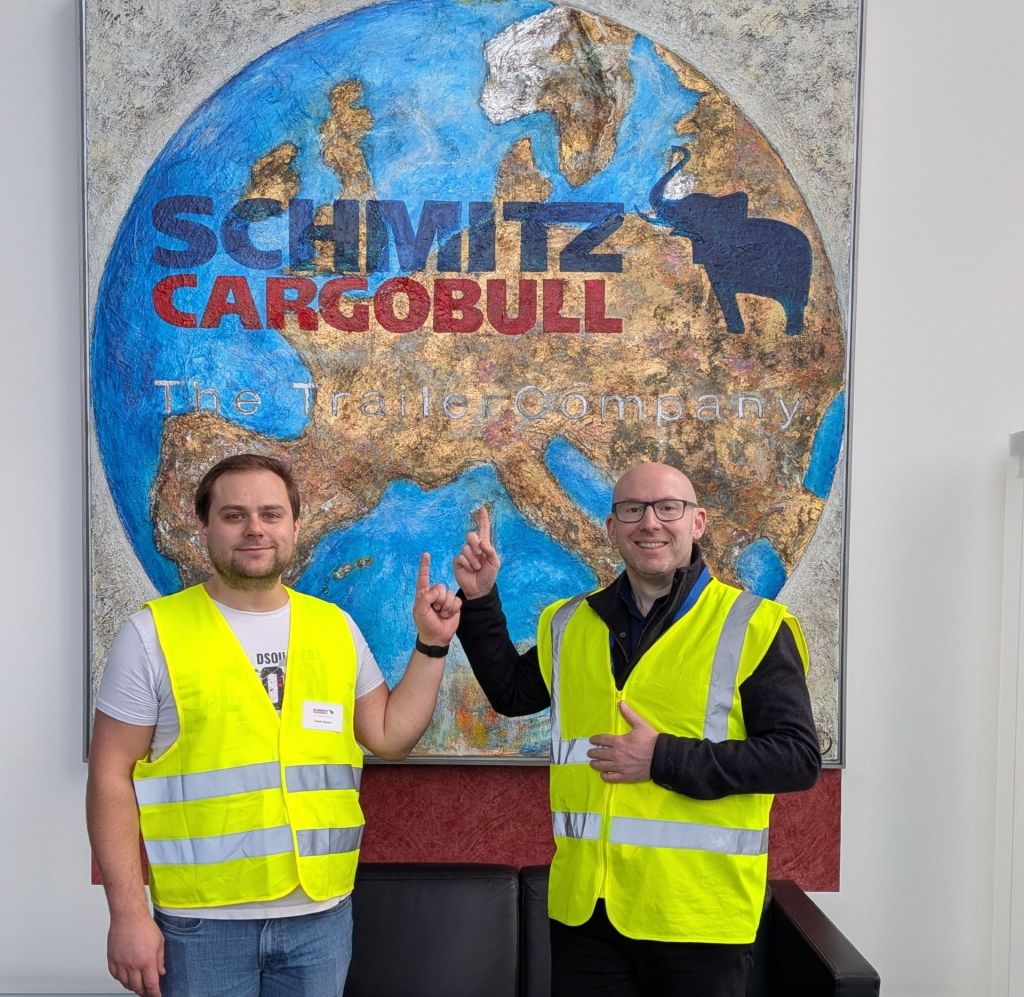
Naturally, HVIA Chief Engineer Rachel Michaud and Chief Technical Officer Adam Ritzinger were keen to accept the invitation of a personal tour of two of its German factories last week, following IAA Transportation in Hannover the week before.
At Schmitz Cargobull, more than 6,000 employees across factories in Germany, Lithuania, Spain, Turkey, Romania and the UK work together to produce around 50,000 trailers annually. Rachel and Adam had a first-hand look at the assembly lines in two of its German locations – Altenberge, which produces general and dry goods trailers, and Vreden, which produces refrigerated and dry freight trailers.
The visit also held particular relevance for the Australian market, with Schmitz Cargobull being the majority shareholder of Freighter Group. While Freighter products continue to be designed and manufactured locally in Australia, the tour provided valuable insight into Schmitz Cargobull’s engineering, production processes and technologies, some of which are being assessed and adopted locally where additional value is added for Australian customers.
Even more impressive than the annual production capacity are the number of subsystems and components that Schmitz Cargobull has brought in-house – cooling units, axles and telematics all proudly bear the Schmitz Cargobull logo.
To date, the company has produced more than two million of its Rotos series axles, approximately 38,000 refrigeration units and over 182,000 TrailerConnect telematics systems. Watching the axle manufacture and chassis beam rolling process in Altenberge was a highlight for Adam.


“The entire axle manufacture workflow is highly automated and incredibly precise,” he says. “Watching the axles come together was second only to the chassis beam rolling machine, which produces profiled chassis rails from rolled sheet steel as easily and quickly as folding paper.”
The incredible flexibility and quality of the Modulos semi-trailer frames impressed Rachel. “The Modulus frame is galvanised, offering incredible protection against corrosion, which we learned was necessary for European roads that are often gritted and salted in winter to manage snow and ice,” she says.
“The real highlight is in the name though – prior to being galvanised, holes are punched into the chassis rails in grid pattern, offering incredible flexibility in placing stiffening structures, suspension attachments and mounting auxiliary components such as brake system hardware,” she adds. “It results in a completely modular system that can be adapted to any variation in customer requirements.”
The HVIA team also watched the patented Schmitz Cargobull Ferroplast refrigerated trailer body technology come to life on the production line. The Ferroplast technology design eliminates pultrusions and thermal bridges through its foam core and steel skin structure, creating a strong, thermally-efficient and moisture-resistant body that is ideal for transporting temperature-sensitive freight.
In Australia, Ferroplast features in Freighter Group’s new Freez-R refrigerated trailer series, which also include the TrailerConnect telematics system as standard.
Finally, Adam and Rachel learned the origins of the name Cargobull. Until 1998, the company name was known as Schmitz Anhänger, with anhänger being the German word for trailer. In an effort to make the name easier to pronounce for non-German speakers, Anhänger was replaced with Cargobull, combining the load-related word cargo with bull, a reference to the company’s blue elephant mascot.