Leading Industry Transition to Electromobility (LITE)
HVIA is supporting the industry on its decarbonisation journey and is harnessing the experience of its members and stakeholders to resolve issues across regulation, policy, skills and training, and infrastructure.
HVIA recommends that when considering policy and regulation as it relates to low and zero emission heavy vehicles (LZEHVs) we are referring to tailpipe emissions, rather than the manufacturing or charging/refuelling process) that this includes all vehicles, and whilst we are in a transition phase, all potential technologies and fuels are explored for different applications – e.g. last mile delivery technology solutions may be different to long-haul road freight solutions.
To help the industry transition, we have formed a committee focused on decarbonisation issues – the LITE (Leading Industry Transition to Electromobility) Committee, which includes OEMs, operators, technology suppliers, consulting engineers, fuel suppliers, and dealers from across the HVIA membership.
Why are heavy vehicles a crucial part of decarbonisation?
According to the Department of Transport and Infrastructure Net Zero Roadmap, the transport sector is currently the third largest source of greenhouse gas emissions (GHGs) in Australia, with direct emissions accounting for 21% of Australia’s GHGs.
When considering Australia’s total transport emissions by origin, articulated trucks and rigid trucks account for approximately 22% (see Figure 1).
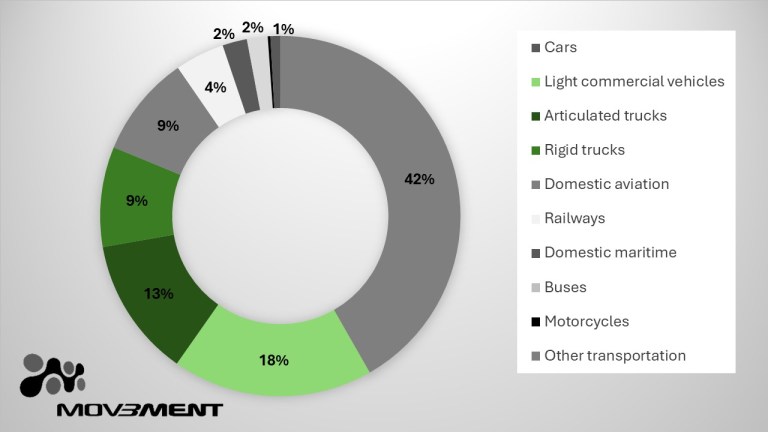
While cars and light commercial vehicles present the majority of transport emissions, failing to properly support heavy vehicles in emission abatement activities represents a significant missed opportunity, one that will undoubtedly create large-scale problems in the future.
The urgency in supporting the transition of the heavy vehicle fleet is further apparent when considering the future domestic freight task.
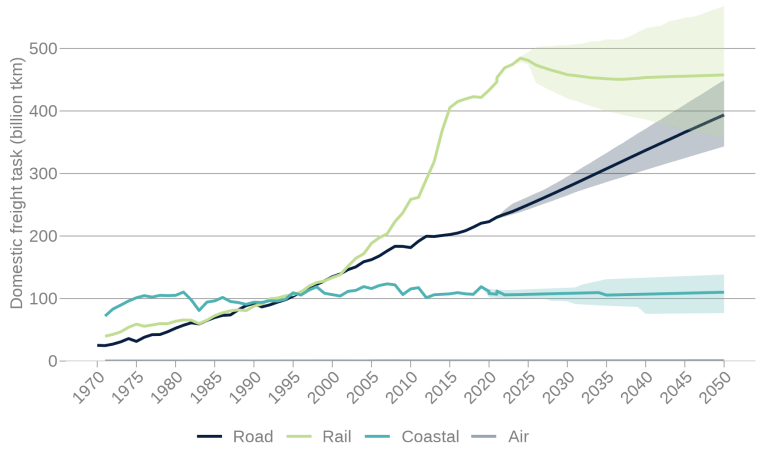
Between 2020 – 2050, road freight is projected to grow by 77%, whereas rail, air, and shipping may not grow as rapidly.
The total freight task is predicted to reach 964 billion tonne-kilometres (btkm) by 2050 from its current level of 765 btkm (see Figure 2).
Support and acknowledgement of the role of heavy vehicles in the transition to net zero is vital – we have the opportunity to get the policy, regulatory, and strategic settings correct from the outset, rather than scrambling to incorporate heavy vehicles into a future designed with only LZE light vehicles in mind.
What does industry need to transition to net zero?
Australia will need multiple solutions to decarbonise road transport, with application of different technologies for different freight tasks. This will include exploring the whole range of options (electric, hydrogen, battery swap, renewable diesel) for their feasibility and potential applications. At present, internal combustion engine (ICE) vehicles still compose the majority of heavy vehicles. Implementing LZEHVs in Australia will require a huge transition, one comparable to when the industry transitioned from horse drawn carriages to ICE vehicles. We do not want the scale of change required for our sector to transition to be misunderstood.
To assist the transition to net zero, the following are required:
– Financial support: incentives for new vehicles (LZEHVs and Euro VI ICE vehicles), technology, and refueling and recharging infrastructure;
– Operational incentives such as curfew reductions, registration reduction and toll discounts;
– Reliable energy supplies for recharging;
– Increased efficiency in the existing fleet;
– New and updated policies, regulations and legislation that keep up with innovation;
– Readily available and affordable low carbon liquid fuels (LCLF).