
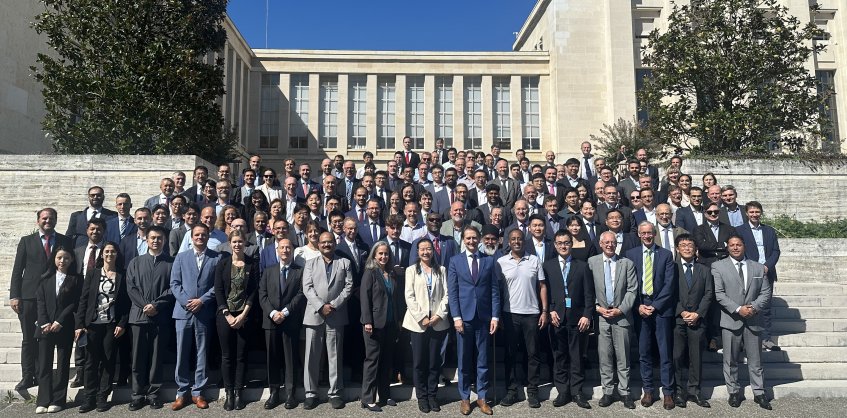
Prior to their visit to IAA in Hannover, HVIA Chief Engineer Rachel Michaud and Chief Technical Officer Adam Ritzinger stopped over in Geneva to attend the 26th session of the GRVA, which is the United Nations Working Party on Automated/Autonomous and Connected Vehicles.
The group is responsible for drafting the safety regulations on vehicle dynamics, vehicle autonomy and safety technology, and cybersecurity, for adoption by UN member states. It sits within the World Forum for Harmonisation of Vehicle Regulations.
The GRVA builds on the 1958 Harmonisation Agreement, which was a global treaty that sought to create uniform technical regulations and mutual type-approval recognition for motor vehicles and their parts. Australia is a Contracting Party to that Agreement, which means that many Australian Design Rules (ADRs) directly follow the United Nations regulations.
Two recent prominent examples are ADR 97/00 (Advanced Emergency Braking) which is based on UN Regulation R131, and ADR 105/00 (Blind Spot Information Systems), which is based on UN Regulation R151. HVIA members have previously broadly supported harmonisation with UN regulations.
Three technical topics were the focus of the 26th session, including vehicle cybersecurity, Automated Driving Systems (ADS) and powered trailers. Each of these topics are highly relevant to many HVIA members and have been the focus of some recent member Working Groups.


UN Regulation R155 (Cyber Security) and R156 (Software Update) are being amended to cover previously omitted provisions. The informal working group submitted multiple documents dealing with equipment retrofitted, where it does not pose a cyber security risk, or is non-automotive equipment already subject to other cyber security provisions. The requirement for multiple type approvals for software revisions is being tackled, and it is made clear that duplication of tests for these approvals shall be avoided where possible.
An additional section was written regarding vehicle transformations (how ‘modifications’ are referred to in Europe) and whether a new vehicle approval is required, dependant on if the transformation will impact the cyber security status.
Regarding automated vehicles, HVIA has provided feedback and submissions to various Australian government bodies that have consulted with industry over the past decade. Insights from the GRVA meeting on implementation and type approval matters will be invaluable when the time comes to discuss local regulations and adoption in the heavy vehicle sector.
Regarding powered trailers, HVIA met representatives from the three European industry associations leading the technical projects exploring safety matters. Those organisations are OICA (International Organisation of Motor Vehicle Manufacturers), CLEPA (European Association of Automotive Suppliers), and the CLCCR (International Association of the Body and Trailer Building Industry). Keeping in close contact with those project leaders will assist Australia’s roll-out of powered trailer technology.