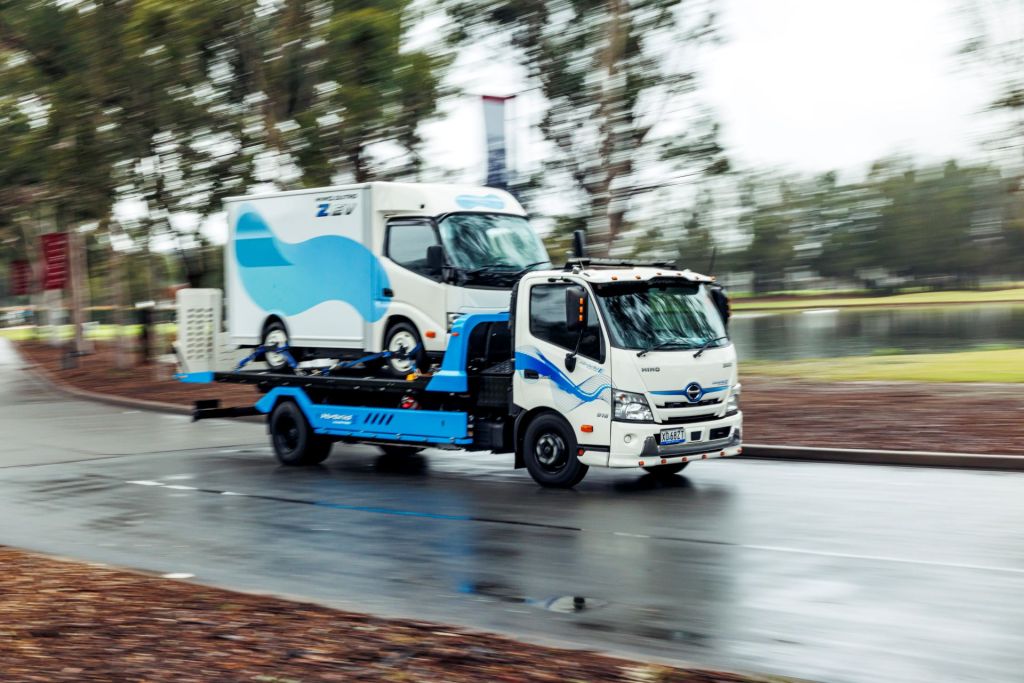
Industry leaders have joined forces to help truck operators reduce fuel costs and make smarter decisions about the future of their fleets, backing a new project called FLEETLEAP that brings together transport industry associations, energy experts and technology providers to give trucking businesses practical, independent advice on fuel efficiency, emissions and the transition to electric vehicles.
Launched at the NatRoad National Conference on the Gold Coast today, the alliance will provide free information and guidance to operators, including small businesses that often lack the time and resources to investigate new technologies or experiment with different practices.
FLEETLEAP is supported by Heavy Vehicle Industry Australia (HVIA), NatRoad, Queensland Transport and Logistics Council (QTLC), Australian Alliance for Energy Productivity (A2EP), National Transport Insurance (NTI), NewVolt, JET Charge and MOV3MENT. Together, the founding partners represent almost 3,000 businesses across Australia’s freight, logistics and energy sectors.
FLEETLEAP will launch with four support areas before expanding to more:
>> A new information hub providing practical advice on reducing fuel consumption and emissions all in one place;
>> A regular electric truck market report, comparing models available in Australia and their specifications;
>> Run on Less Australia, a real-world demonstration of how electric trucks perform on Australian roads, on real routes carrying real freight; and
>> A fleet advice service helping operators understand their opportunities, including whether electric trucks are suitable for their business and how to make the switch.
FLEETLEAP will continue building on its resources, including practical tools, industry data and case studies to help operators make informed decisions.
MOV3MENT Managing Director Mark Gjerek says the new initiative will help businesses make informed decisions without wasting money on solutions that may not suit their operations.
“Every litre of diesel saved makes a difference. Something as simple as choosing the right tyres or fitting aerodynamic fairings can reduce fuel costs by up to five per cent,” he says.
“We’re also seeing differences of more than 20 per cent in fuel consumption between drivers operating the same truck. That’s money businesses could be saving right now.
“Electric trucks are becoming viable for more operators so that is one focus area. But they don’t yet work everywhere, and we want businesses to understand all opportunities to reduce fuel costs and emissions that make commercial sense for them.”
NatRoad CEO Warren Clark says smaller operators in particular need practical advice they can trust.
“Most trucking businesses are small operations. Their owners are focused on keeping trucks moving and making ends meet, not spending weeks researching new technologies,” he says.
“With diesel prices where they are, even modest savings can make a real difference to a business’s bottom line. Operators need to know what they can do today to reduce costs, while understanding the options available for the future.”
Representing industry suppliers, HVIA CEO Todd Hacking adds, “All of us have been supporting the freight industry to become more sustainable. We’ve held two very successful editions of TruckShowX showing these technologies in action.
“FLEETLEAP shows we can work together as an industry to not duplicate projects, and coordinate and connect our efforts across the sector and with government.”
FLEETLEAP has received funding from Australian Renewable Energy Agency (ARENA) to support some of its electric truck initiatives, including the Run on Less event.
ARENA CEO Darren Miller says the project creates a forum for collaboration that the freight industry hasn’t had at this scale to-date.
“By bringing these stakeholders together in one alliance, it gives the industry a vital platform to coordinate efforts, share what they learn, and move faster together,” he says. “This is a challenge no single company could solve alone.”
Lauren Hewitt, CEO of QTLC, highlights the strong appetite for independent information. “With technology and costs constantly changing, operators and precincts need to regularly assess their options, and this takes time and effort.
“By collaborating to provide an independent and tech-agnostic platform, we’re aiming to inform and de-risk the productivity pathway,” she says.
A2EP CEO Jarrod Leak concurs. “Fleets want to cut costs and their customers want reduced supply chain emissions. Both are possible, but fleet owners need trustworthy, actionable information. That’s what FLEETLEAP offers.”
JET Charge CEO Tim Washington notes that trucks are where electrification can deliver the biggest savings in cost and emissions. “Our analysis shows a 100-vehicle heavy fleet could save around $4.5 million a year in fuel by switching to electric.
“FLEETLEAP will give operators clear, independent advice on where electric trucks work today, and we’ll help them get the charging right,” he says.
NewVolt Co-Founder Rainer Knobloch sees similar benefits, noting that fleet electrification will play out over decades. “Putting one or two electric trucks on the road is the easy part. Most operators need help working out how to get from there to a scaled fully electric fleet. That information just isn’t out there for Australian fleets yet.”
As Australia’s leading specialist transport and logistics insurance provider, NTI sees an important role in supporting the industry as it navigates the transition to lower-emissions transport. NTI Chief People and Services Officer Kerrie Challenor says joining FLEETLEAP is a natural extension of that commitment.
“Decarbonisation is a significant challenge for the transport and logistics industry, and the transition will look different for different operators,” she says.
“We want to support the industry by helping ensure businesses have access to practical, trusted information that enables them to make informed decisions about the technologies and solutions that are right for their operations.”
Other organisations across the freight supply chain are invited and encouraged to participate or to register for updates.
For more information, visit here.